
Read the transcript
Slot trenching in Wollongong:
how a vac truck crew proves buried services along a line.
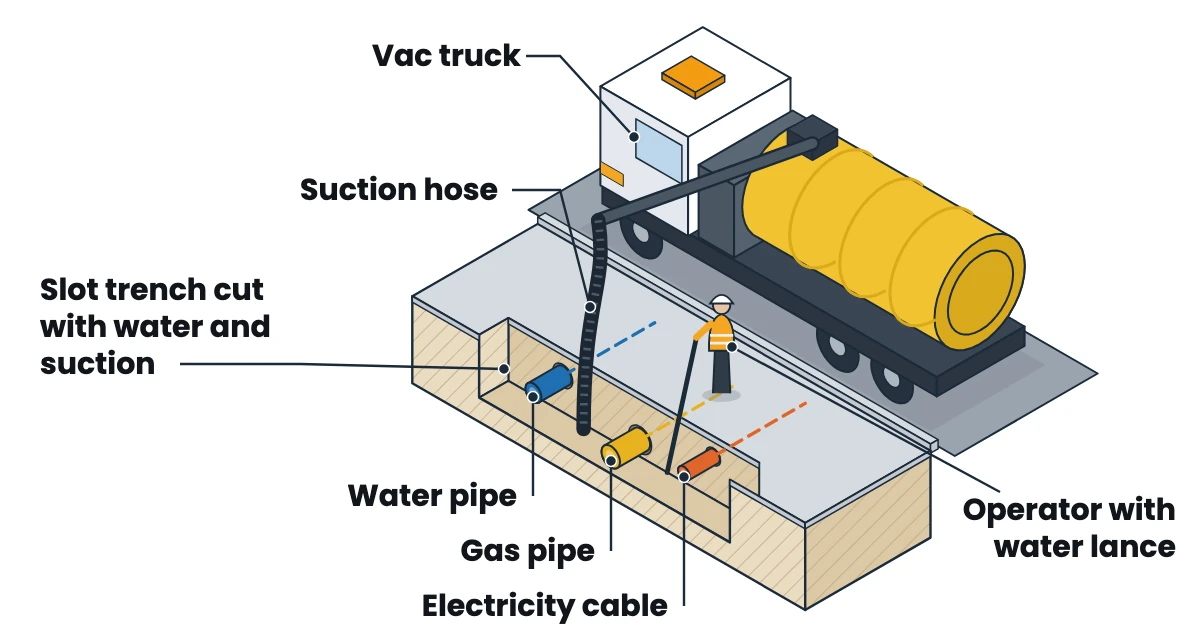
Slot trenching is cutting a narrow trench with water and suction so every buried service along a line can be seen before the real work starts.
Where potholing checks one spot, a slot trench checks the whole run:
across a footpath before a bore, along the route of a new conduit, or across a driveway where a connection has to go in.
It is one of the jobs our non-destructive digging service is commonly used for across Wollongong.
A vac truck suits a long, narrow cut.
The water lance breaks up the ground a short length at a time and the suction hose clears it into the tank, so each crossing pipe or cable is left in place to be seen, with no bucket or blade near it.
Rapid Vac Trucks Wollongong provides vacuum slot trenching across Wollongong and the Illawarra, and every truck arrives with an experienced operator.
Key takeaways.
A slot trench exposes every service that crosses your dig line, not only the spots you pothole.
Plans are the start, but SafeWork NSW and Sydney Water both say they may not be accurate or complete.
Illawarra asset owners set limits on water pressure, nozzle distance and machine digging near their assets.
Our crew opens the slot and exposes each service so its position and depth can be checked and recorded before you dig, bore or lay conduit.
When a slot trench beats a row of potholes.
Choose a slot trench when you need to know about everything along a line, not just at a few points.
Potholes are the right tool for confirming a service you already know about.
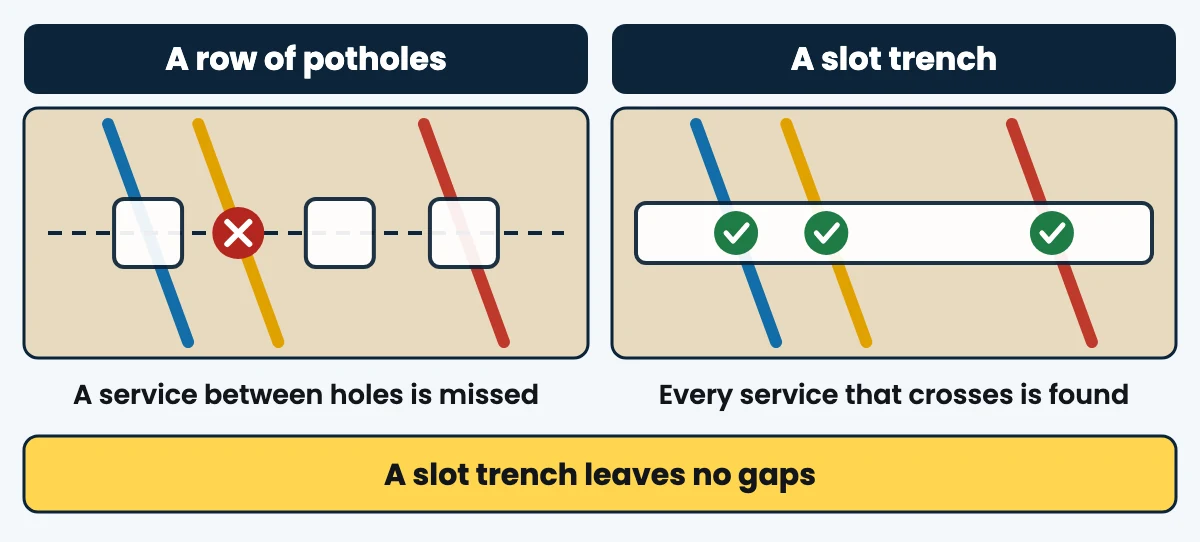
A row of potholes along a long route can still miss a pipe or cable that crosses between two holes, and that is the one a bore head or an excavator finds.
SafeWork NSW's Code of Practice for excavation work says the information you hold about underground services may not be accurate, so excavation should begin with an initial check, for example exposing a short section of the services with water pressure and a vacuum system.
Its newer code for work near overhead and underground electric lines, from May 2026, goes further for boring:
when you bore parallel to an electricity asset, it may be necessary to dig trial holes at points along the route to prove where the asset is.
A slot trench is the continuous version of that check.
Typical Wollongong jobs where it pays off:
before a bore or under-road crossing, to cut across the expected line of services and confirm each one the bore will pass.
Along a new conduit or pipe route in a footpath or nature strip, where water, gas, power and telecoms often run side by side.
At a new connection or driveway, where property service lines may not be on any plan.
And on a busy or tight site, where the spoil has to leave as it is dug rather than sit in a pile.
Who owns what under an Illawarra street.
In the Illawarra, three networks set most of the rules you dig to:
Endeavour Energy for electricity, Jemena for gas and Sydney Water for water, wastewater and stormwater.
Telecommunications owners are reached through the same Before You Dig Australia enquiry, which Endeavour Energy describes as a single point of contact for all the infrastructure networks on your project site.
Endeavour Energy's network covers the Illawarra and the NSW South Coast, Jemena operates gas distribution throughout NSW and the ACT, and Sydney Water says it serves the Sydney, Blue Mountains and Illawarra regions.
Here is what each one asks for, from its own published guidance.
Endeavour Energy asks you to get and check every Before You Dig plan, to use potholing and non-destructive digging before excavation, and to avoid digging around street lights, padmount substations and pillar boxes until it has given guidance.
Its own electrical safety rules, written for people working on or near its network, treat non-destructive excavation above two thousand P S I as powered excavation.
Jemena asks for gas mains to be located by potholing, and, where permitted, for hydro vac to find the main's position and depth along the excavation and mark the centreline.
It sets water pressure limits by pipe material, measured at the lance.
The nozzle stays at least 300 mm from the main, there is no vacuum excavation on coal tar enamel coated mains, and a Jemena standby is needed within 3 m of a secondary or critical main.
Sydney Water's steps are plan, pothole, protect, proceed, and its guidance asks that excavation be carried out manually until all services are located.
Its plans are a guide only, wastewater and stormwater depths vary significantly, and plans may not show every property connection.
Endeavour Energy also says that in NSW you are legally required to use a Before You Dig Australia referral before any excavation.
The enquiry is free, including on private property, and Before You Dig Australia says members are encouraged to respond within two business days, so lodge it early.
Endeavour adds that cable depths vary greatly over time, which is exactly why exposing the cable beats assuming its depth.
If your slot crosses a new service route, plan the crossings too.
Jemena's construction guideline asks for other utilities to cross underneath gas mains where possible, and sets minimum separations such as 300 mm from low and medium pressure plastic mains.
The slot trench shows you the real depth of the gas main, so the crossing can be designed from fact.
Depth, trench sides and spoil.
However narrow the slot, the trench rules still apply as it gets deeper.
The excavation work code says a business that proposes to excavate a trench at least one point five metres deep must, so far as is reasonably practicable, secure the area from unauthorised entry and support all sides by shoring, benching or battering.
Where a worker entering a trench could be engulfed, it says those controls should be used whatever the depth.
Work in or near a trench deeper than one point five metres is high risk construction work and needs a safe work method statement, and the code requires one for excavation work involving underground services.
A vac truck keeps the work area clear.
With vacuum trenching, the spoil and water go up the suction hose into the tank as the slot is cut, so there is no mud pile on the edge loading the trench sides or blocking a footpath.
How the recovered material is disposed of depends on what it is and is confirmed for each job.
How our crew opens a slot trench.
Our operator works the line in short lengths with the water lance and the suction hose, exposing each service as it appears and leaving it in place for you to see.
One.
Plans and owner conditions.
Send us your Before You Dig plans and any asset owner pack, such as a Jemena standby requirement or Endeavour Energy safety advice for your site.
Two.
Locate and mark.
A locator or ground penetrating radar marks the expected services on the ground, so the slot runs where it will cross them.
You can book our service locator or ground penetrating radar work first.
Three.
Cut the slot.
The truck sets up at the kerb or on site and the operator cuts the slot with water and suction, working to the pressure and nozzle limits the asset owners set for each service.
Four.
Record each service.
With each pipe or cable in sight, its position, depth and direction are checked and recorded, along with anything that was not on the plans.
Five.
Dig, bore or lay conduit.
With every crossing on record, your machine or bore crew works the line knowing what is there, and keeps clear of the distances each asset owner sets.
Water pressure is matched to what is in the ground.
Jemena's guideline lists maximum water pressures by pipe material and says pressure is measured at the lance, not the truck, and Endeavour Energy's own network safety rules draw the line at two thousand P S I.
Tell us what your plans show and our operator plans the dig to those limits.
What the record should show.
The record is what lets the main crew dig with confidence:
a plain account of the whole slot.
Agree who keeps the record, and in what form, when you book.
For a slot trench it should cover the start and end of the slot, tied to the site marks; every crossing service, in order along the line, and any length that was clear; the cover depth to each one; its direction, and anything the plans did not show; and photos along the open slot.
Keep it with your plans and give it to whoever does the main excavation.
SafeWork NSW's excavation work code says the information about underground services must be made available to workers, the principal contractor and subcontractors, and kept until the excavation work is finished, or two years after a notifiable incident.
What to send us for a quote.
Every slot trenching job is planned from the details you send.
Have these ready:
the address and the line, where the slot, bore or conduit will run, and how long it is.
Your current Before You Dig plans, every response.
Any locator or ground penetrating radar mark-out, or ask us to do it first.
The depth your design needs, so the slot goes deep enough to clear it.
Asset owner conditions, such as a Jemena standby or Endeavour Energy safety advice.
Private services the owner or occupier knows about, such as irrigation or power to a shed.
Access and surface:
where the truck can park, gates, traffic, and any concrete or asphalt that has to be cut first.
And your safe work method statement and induction details.
Call oh two, four two one four, four one one six to talk it through, or upload photos or a site plan with the quote form.
You can call the Wollongong team twenty-four seven, including for emergency work, with timing confirmed when the job is scoped.
Frequently asked questions.
What is slot trenching?
Slot trenching is cutting a narrow trench with a vac truck's water lance and suction hose to expose every buried service along a line, so the main excavation, bore or conduit can go in without hitting them.
Is slot trenching the same as potholing?
They use the same method.
Potholing exposes a service at one spot.
A slot trench is continuous, so it also finds services that cross the line between holes.
Do I still need Before You Dig plans?
Yes.
Endeavour Energy says a Before You Dig Australia referral is a legal requirement in NSW before excavation, and the enquiry is free.
The plans show where to cut the slot; the slot shows what is really there.
How deep can a slot trench go?
To the depth your design calls for.
Once a trench is one point five metres deep, the sides must be supported and the area secured, and SafeWork NSW's code says those controls should be used at any depth where a worker entering the trench could be engulfed.
SafeWork NSW gives typical depths of 450 to 750 mm for low voltage cables, but real depths vary, so tell us what your plans and design show.
Does the truck come with an operator?
Yes, always.
Every Rapid Vac Trucks Wollongong job is a vac truck with an experienced operator, planned around your site and the asset owners' conditions.
This guide is general information, not safety or legal advice.
Codes and asset owner conditions change, so check the current SafeWork NSW codes, your Before You Dig Australia plans and each asset owner's requirements for your site before work starts.
Slot trenching is cutting a narrow trench with water and suction so every buried service along a line can be seen before the real work starts. Where potholing checks one spot, a slot trench checks the whole run: across a footpath before a bore, along the route of a new conduit, or across a driveway where a connection has to go in. It is one of the jobs our non-destructive digging service is commonly used for across Wollongong.
A vac truck suits a long, narrow cut. The water lance breaks up the ground a short length at a time and the suction hose clears it into the tank, so each crossing pipe or cable is left in place to be seen, with no bucket or blade near it. Rapid Vac Trucks Wollongong provides vacuum slot trenching across Wollongong and the Illawarra, and every truck arrives with an experienced operator.
Key takeaways
- A slot trench exposes every service that crosses your dig line, not only the spots you pothole.
- Plans are the start, but SafeWork NSW and Sydney Water both say they may not be accurate or complete.
- Illawarra asset owners set limits on water pressure, nozzle distance and machine digging near their assets.
- Our crew opens the slot and exposes each service so its position and depth can be checked and recorded before you dig, bore or lay conduit.
When a slot trench beats a row of potholes
Choose a slot trench when you need to know about everything along a line, not just at a few points. Potholes are the right tool for confirming a service you already know about. A row of potholes along a long route can still miss a pipe or cable that crosses between two holes, and that is the one a bore head or an excavator finds.
SafeWork NSW's Code of Practice: Excavation work says the information you hold about underground services may not be accurate, so excavation should begin with an initial check, for example exposing a short section of the services with water pressure and a vacuum system. Its newer code for work near overhead and underground electric lines (May 2026) goes further for boring: when you bore parallel to an electricity asset, it may be necessary to dig trial holes at points along the route to prove where the asset is.
A slot trench is the continuous version of that check. Typical Wollongong jobs where it pays off:
- Before a bore or under-road crossing, to cut across the expected line of services and confirm each one the bore will pass.
- Along a new conduit or pipe route in a footpath or nature strip, where water, gas, power and telecoms often run side by side.
- At a new connection or driveway, where property service lines may not be on any plan.
- On a busy or tight site, where the spoil has to leave as it is dug rather than sit in a pile.
Who owns what under an Illawarra street
In the Illawarra, three networks set most of the rules you dig to: Endeavour Energy for electricity, Jemena for gas and Sydney Water for water, wastewater and stormwater. Telecommunications owners are reached through the same Before You Dig Australia enquiry, which Endeavour Energy describes as a single point of contact for all the infrastructure networks on your project site. Endeavour Energy's network covers the Illawarra and the NSW South Coast, Jemena operates gas distribution throughout NSW and the ACT, and Sydney Water says it serves the Sydney, Blue Mountains and Illawarra regions.
Here is what each one asks for, from its own published guidance:
| Asset owner | What it asks before and during the dig | Limits and cautions it states |
|---|---|---|
| Endeavour Energy (electricity) | Get and check every Before You Dig plan; use potholing and non-destructive digging before excavation; avoid digging around street lights, padmount substations and pillar boxes until it has given guidance | Its own electrical safety rules, written for people working on or near its network, treat non-destructive excavation above 2000 PSI as powered excavation |
| Jemena (gas) | Locate gas mains by potholing; where permitted, use hydro vac to find the main's position and depth along the excavation and mark the centreline | Water pressure limits by pipe material, measured at the lance; nozzle at least 300 mm from the main; no vacuum excavation on coal tar enamel coated mains; a Jemena standby within 3 m of a secondary or critical main |
| Sydney Water (water, wastewater, stormwater) | Plan, pothole, protect, proceed; its guidance asks that excavation be carried out manually until all services are located | Plans are a guide only; wastewater and stormwater depths vary significantly; plans may not show every property connection |
Endeavour Energy also says that in NSW you are legally required to use a Before You Dig Australia referral before any excavation. The enquiry is free, including on private property, and BYDA says members are encouraged to respond within 2 business days, so lodge it early. Endeavour adds that cable depths vary greatly over time, which is exactly why exposing the cable beats assuming its depth.
If your slot crosses a new service route, plan the crossings too. Jemena's construction guideline asks for other utilities to cross underneath gas mains where possible, and sets minimum separations such as 300 mm from low and medium pressure plastic mains. The slot trench shows you the real depth of the gas main, so the crossing can be designed from fact.

Depth, trench sides and spoil
However narrow the slot, the trench rules still apply as it gets deeper. The Excavation work code says a business that proposes to excavate a trench at least 1.5 metres deep must, so far as is reasonably practicable, secure the area from unauthorised entry and support all sides by shoring, benching or battering. Where a worker entering a trench could be engulfed, it says those controls should be used whatever the depth. Work in or near a trench deeper than 1.5 metres is high risk construction work and needs a safe work method statement (SWMS), and the code requires a SWMS for excavation work involving underground services.
A vac truck keeps the work area clear. With vacuum trenching, the spoil and water go up the suction hose into the tank as the slot is cut, so there is no mud pile on the edge loading the trench sides or blocking a footpath. How the recovered material is disposed of depends on what it is and is confirmed for each job. Our liquid waste removal page covers slurry and sediment-laden water.
How our crew opens a slot trench
Our operator works the line in short lengths with the water lance and the suction hose, exposing each service as it appears and leaving it in place for you to see.
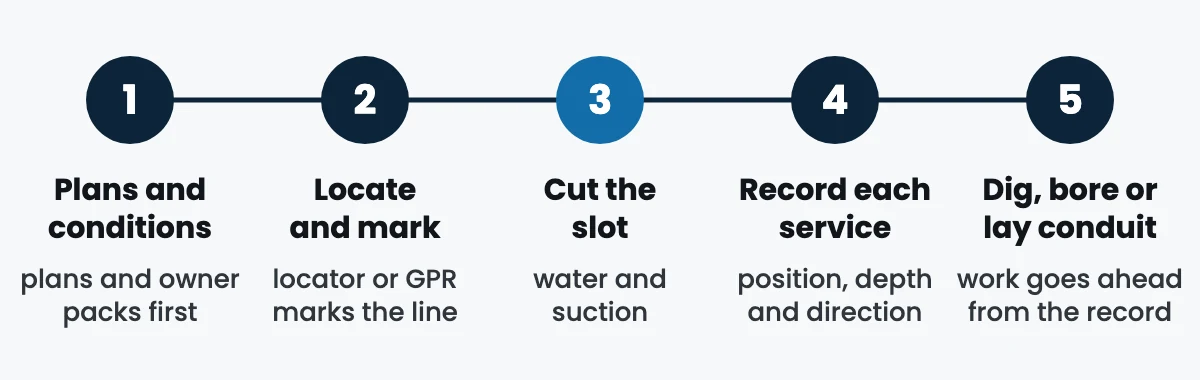
- Plans and owner conditions. Send us your Before You Dig plans and any asset owner pack, such as a Jemena standby requirement or Endeavour Energy safety advice for your site.
- Locate and mark. A locator or ground penetrating radar marks the expected services on the ground, so the slot runs where it will cross them. You can book our service locator or ground penetrating radar work first.
- Cut the slot. The truck sets up at the kerb or on site and the operator cuts the slot with water and suction, working to the pressure and nozzle limits the asset owners set for each service.
- Record each service. With each pipe or cable in sight, its position, depth and direction are checked and recorded, along with anything that was not on the plans.
- Dig, bore or lay conduit. With every crossing on record, your machine or bore crew works the line knowing what is there, and keeps clear of the distances each asset owner sets.
Water pressure is matched to what is in the ground. Jemena's guideline lists maximum water pressures by pipe material and says pressure is measured at the lance, not the truck, and Endeavour Energy's own network safety rules draw the line at 2000 PSI. Tell us what your plans show and our operator plans the dig to those limits.
Prove the whole line before you dig
Call the Wollongong team to book a vac truck and operator for slot trenching, or send your plans and photos for a quote.
What the record should show
The record is what lets the main crew dig with confidence: a plain account of the whole slot. Agree who keeps the record, and in what form, when you book. For a slot trench it should cover:
- the start and end of the slot, tied to the site marks;
- every crossing service, in order along the line, and any length that was clear;
- the cover depth to each one;
- its direction, and anything the plans did not show;
- photos along the open slot.
Keep it with your plans and give it to whoever does the main excavation. SafeWork NSW's Excavation work code says the information about underground services must be made available to workers, the principal contractor and subcontractors, and kept until the excavation work is finished (or two years after a notifiable incident).

What to send us for a quote
Every slot trenching job is planned from the details you send. Have these ready:
- Address and the line: where the slot, bore or conduit will run, and how long it is.
- Current Before You Dig plans: every response.
- Any locator or GPR mark-out, or ask us to do it first.
- The depth your design needs, so the slot goes deep enough to clear it.
- Asset owner conditions, such as a Jemena standby or Endeavour Energy safety advice.
- Private services the owner or occupier knows about, such as irrigation or power to a shed.
- Access and surface: where the truck can park, gates, traffic, and any concrete or asphalt that has to be cut first.
- Your SWMS and induction details.
Call (02) 4214 4116 to talk it through, or upload photos or a site plan with the quote form. Our vacuum excavation page explains the method in more detail, plumbers can read how hydro excavation helps on plumbing jobs, and civil crews can see where vacuum excavation fits on construction sites. You can call the Wollongong team 24/7, including for emergency work, with timing confirmed when the job is scoped.
Book slot trenching in Wollongong
Send your plans and site details and we will plan the vac truck and operator around your job anywhere in Wollongong and the Illawarra.
Frequently asked questions
What is slot trenching?
Slot trenching is cutting a narrow trench with a vac truck's water lance and suction hose to expose every buried service along a line, so the main excavation, bore or conduit can go in without hitting them.
Is slot trenching the same as potholing?
They use the same method. Potholing exposes a service at one spot. A slot trench is continuous, so it also finds services that cross the line between holes.
Do I still need Before You Dig plans?
Yes. Endeavour Energy says a Before You Dig Australia referral is a legal requirement in NSW before excavation, and the enquiry is free. The plans show where to cut the slot; the slot shows what is really there.
How deep can a slot trench go?
To the depth your design calls for. Once a trench is 1.5 metres deep, the sides must be supported and the area secured, and SafeWork NSW's code says those controls should be used at any depth where a worker entering the trench could be engulfed. SafeWork NSW gives typical depths of 450 to 750 mm for low voltage cables, but real depths vary, so tell us what your plans and design show.
Does the truck come with an operator?
Yes, always. Every Rapid Vac Trucks Wollongong job is a vac truck with an experienced operator, planned around your site and the asset owners' conditions.
This guide is general information, not safety or legal advice. Codes and asset owner conditions change, so check the current SafeWork NSW codes, your Before You Dig Australia plans and each asset owner's requirements for your site before work starts. Sources were checked in November 2026.